
Archives
-

Epistemic DisobedienceEpistemic Disobedience and Epistemologies of the South: Decolonial, Intersectional, and Transfeminist Third World Perspectives and Epistemologies of the South: Decolonial, Intersectional, and Transfeminist Third World Perspectives
Vol. 5 No. 2 (2025)This dossier proposes an analysis of epistemic disobedience as a fundamental movement to question and subvert the Eurocentric and Western structures that dominate scientific production, especially in the areas of humanities, gender studies, sexuality, ethnic-racial relations, and class. From a decolonial perspective, the dossier seeks to destabilize hegemonic narratives that exclude and silence knowledge originating from marginalized contexts, proposing the valorization of epistemologies from the South and the incorporation of intersectional and transfeminist approaches. By challenging traditional dichotomies, such as subject/object and human/non-human, and by questioning the epistemological foundations that underpin colonialism, this dossier advocates a reconfiguration of knowledge that takes into account the multiple realities of historically subalternized groups. This dossier, therefore, seeks to bring together works that explore these themes in a critical and proactive manner, encouraging a review of the practices and policies of knowledge production, and promoting an academy that engages with processes of resistance and transformation, both within the academic sphere and in broader social spheres.
-

Women and the media
Vol. 5 No. 1 (2025)The thematic dossier “Women and the Media” brings together articles that problematize the presence, representation and agency of women in various media formats, through an interdisciplinary approach anchored in the fields of Women's History, Gender Studies, Communication and Critical Media Analysis. The proposal is based on the understanding that the media not only reflect, but also produce and reconfigure social discourses, normativities and dissent, and are therefore privileged spaces for the analysis of the power dynamics that permeate bodies, subjectivities and temporalities.
The translation, carried out by Ana Carolina Eiras Coelho Soares, of the essay entitled "After History?" by Joan W. Scott, presented here, aims to expand access in Portuguese to a fundamental text for contemporary historiographical debates. Produced in the context of the “history wars” in the United States and originally published in 2001, the text remains current by challenging naturalized conceptions of objectivity, truth and identity in the writing of history.
-

Women, Territories and Violence: stories of struggles
Vol. 4 No. 2 (2024)Studies in the area of Human Sciences, among other areas of science, show that colonialisms and colonialities have systematically violated peoples and individuals in Latin America and the Caribbean. Such reflections indicate that these structures intersect practices based on concepts of race, gender, class, sexuality and generation, reflecting long-standing patterns of colonial violence. In this context, the dossier “Women, Territories and Violence: Stories of Struggles”, published by Revista Anômalas, a publication of the Research and Studies Group on Gender, Sexualities, Class and Ethnicities/Race (ANÔMALOS/UFCAT/CNPQ) and the Institute of History and Social Sciences of the Federal University of Catalão (INHCS/UFCAT), presents articles that explore aspects of the structure of violence in the history of contemporary Brazil.
-

Trans/transvestite knowledge in dispute
Vol. 4 No. 1 (2024)The last decades have seen the centralization of debates related to trans/transvestite people - as well as their presence - in public space, from institutional policy to mass media, from art circuits to academic research. In Brazilian higher education, this presence is seen in the growing access of trans/transvestite people to learning and teaching, as well as in the controversies about their knowledge and their legitimacy in these spaces.
Therefore, this dossier in Revista Anômalas calls for such “trans/transvestite knowledge in dispute”, centralizing the production carried out, in Brazil and abroad, by trans/transvestite people/, and/or in direct dialogue with such authors. We invite trans/transvestite people and cis people from different positions, areas of knowledge, and stages of training, as well as activists, artists, and professionals from different areas, to participate by sending academic articles; individual and co-authored essays and manifestos; in addition to reviews and translations related to the dossier proposal in Portuguese, Spanish and English.
-

Quitanda das Minas: mulheres e histórias
Vol. 3 No. 2 (2023)This dossier is based on the urgency to contribute to the dissemination of research that rescues women and their plots in different space-time frames, so that we can construct, in scientific narratives, versions of the warps, trajectories and actions of marginalized subjects who, inserted in sociopolitical dynamics of social invisibility and historical silencing bring us the need to think about the different Women and their Stories throughout time. From this introduction, built together with our objectives and justifications for the preparation of this dossier, we configured this issue with five thematic articles and, at the end of the copy, we have a book review and an interview with a researcher on topics that relate to the field of Women's History.
-
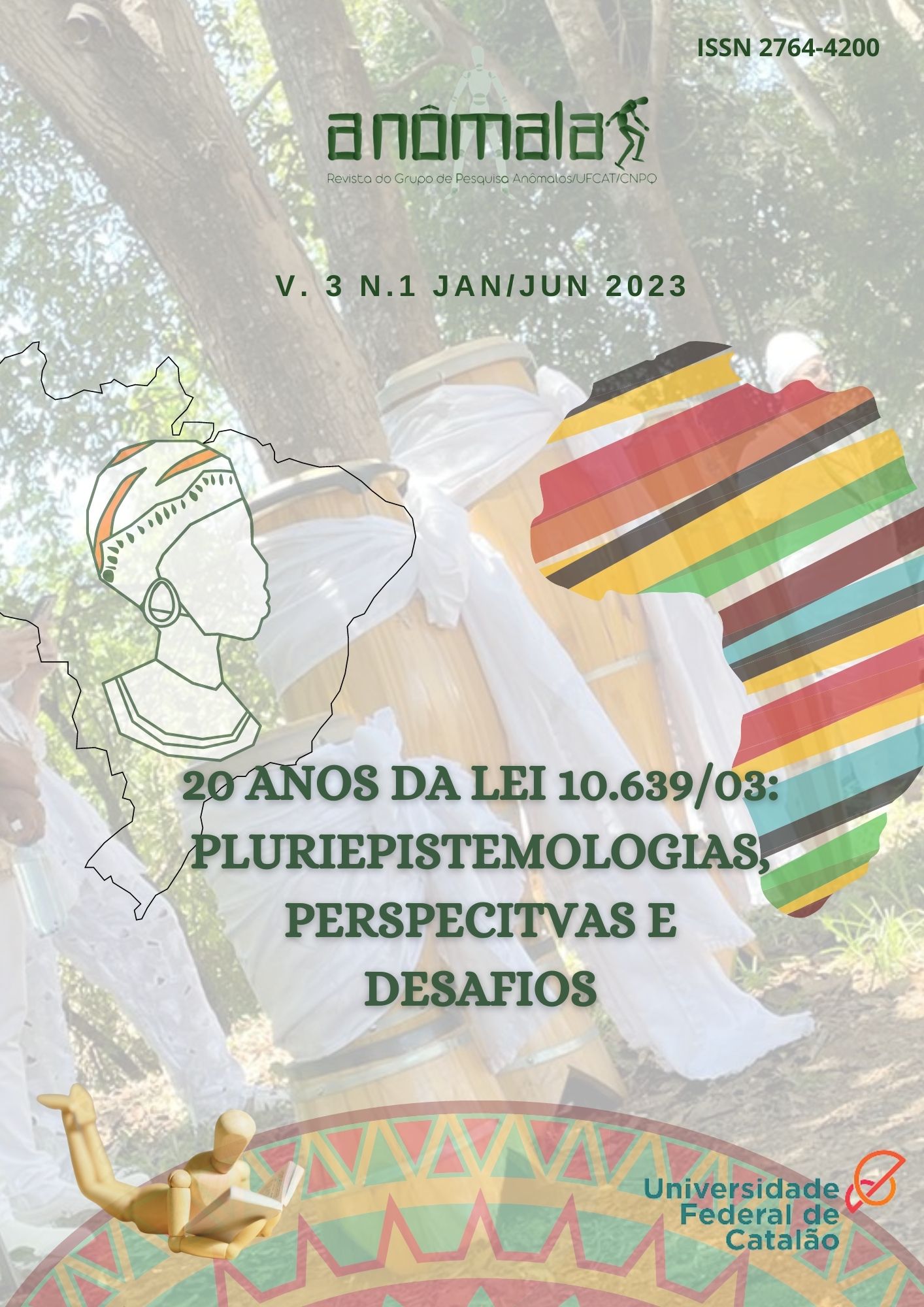
20 years of Law 10,639/03: Pluriepistemologies, perspectives and challenges
Vol. 3 No. 1 (2023)After centuries of resistance, exercised in different ways and in the most diverse contexts, we are completing 20 years of a historic milestone in Brazilian education. Law 10,639/2003 brought to our research, teaching and social action scenario the recognition of the urgency of combating racism, which, across the board, affects the economic, political, educational, ethical and environmental spheres of our country. In 2008, Law 11,645 also strengthened dialogues with themes specific to the epistemic universes of indigenous and Afro-diasporic societies. The search for valuing these ancient experiences and knowledge also provided us with dialogue with black and indigenous thinkers, which until then was almost non-existent in the context of basic and higher education. Recognizing the countless challenges that have not yet been overcome, we propose to receive articles, reviews, interviews and reports of experiences aimed at building an intercultural education that challenges the Eurocentric Western monotopy. Based on interchangeability in the production of knowledge, Revista Anômalas is not restricted to historiographical texts, opening space for proposals elaborated in different fields of knowledge.
-

Popular Education and Intersectionality
Vol. 2 No. 2 (2022)Reunimos aqui escritos comprometidos com a educação popular em uma perspectiva interseccional. Partindo da compreensão de que o conceito de interseccionalidade se encontra em um campo de disputa, estabelece-se o posicionamento junto às perspectivas da educação popular, comprometida com o reconhecimento e a superação das realidades de opressão de raça, gênero e classe.
-

Communities, well-being and counter-hegemonic narratives
Vol. 2 No. 1 (2022)Dear readers,
We publish issue 01 of 2022 firsthand. In this issue, we broadly discuss political and theoretical efforts to understand and experiment with forms of counter-hegemonic narratives. This edition also has a Free Section, Interview and Review.
Cover credits: Alessandra Pereira Machado (editing), Dayane Nascimento Sobreira, Flávia Brito, Flávia Pereira Machado.
-

Epistemic Crossroads: Intersectionalities in Debate II
Vol. 1 No. 2 (2021)To the readers,
We publish first the second issue of Revista Anômalas. Many waters have flowed since the idealization of this magazine - political crisis, health crisis, representation crisis. In a social and political context like this, it is necessary to join forces, voices and hope. It is for this reason that this magazine was created and it is under this trench that we wish to fight.
We dedicate this issue to the intellectual André Malink, who makes an anti-disciplinary contribution in the second part of the dossier Encruzilhadas Epistemicas. Unfortunately, before the publication of the magazine, Malinksi left us. We offer all solidarity to family members, friends and friends who, like us, will continue to make their ideas viable. Anômalas once again salutes the body that seeks social transformation. It is necessary to instrumentalize the struggle, it is necessary to instrumentalize listening, and the Encruzilhadas Epstómicas Dossier amplifies these voices from a radical process of search for life and for the formation of a full citizenship.
We thank, above all, the efforts of the evaluators and evaluators. In addition, we are happy to have public funding from the Academic Unit of History and Social Sciences at the Federal University of Catalão. It is from this sum of efforts that Anomalas comes to life.
Despite countless adversities, the body of Anômalas takes shape from scientific texts and voices that dare to challenge all oppressions.
We wish you a good reading!
-

Epistemic Crossroads: Intersectionalities in Debate I
Vol. 1 No. 1 (2021)To the readers,
We published firsthand the first issue of Revista Anômalas. Many waters have flowed since the idealization of this magazine - political crisis, health crisis, representation crisis. In a social and political context like this, it is necessary to join forces, voices and hope. It is for this reason that this magazine was created and it is under this trench that we wish to fight.
We dedicate this first issue to all the lives that continue to fight even in the face of the exhaustion of strength and prospects for the future. Anômalas once again salutes the body that seeks social transformation. It is necessary to instrumentalize the struggle, it is necessary to instrumentalize listening and the Epistle Encruzilhadas Dossier expands these voices from a radical process of search for life and the formation of a full citizenship.
We thank, above all, the efforts of the evaluators and evaluators. In addition, we are happy to have public funding from the Academic Unit of History and Social Sciences at the Federal University of Catalão. It is from this sum of efforts that Anomalas comes to life.
Despite countless adversities, the body of Anômalas takes shape from scientific texts and voices that dare to challenge all oppressions.
We wish you a good reading!


